Written by: Denwigwe Blossom U.
AI‑Generated Evidence and Admissibility in Nigerian Courts
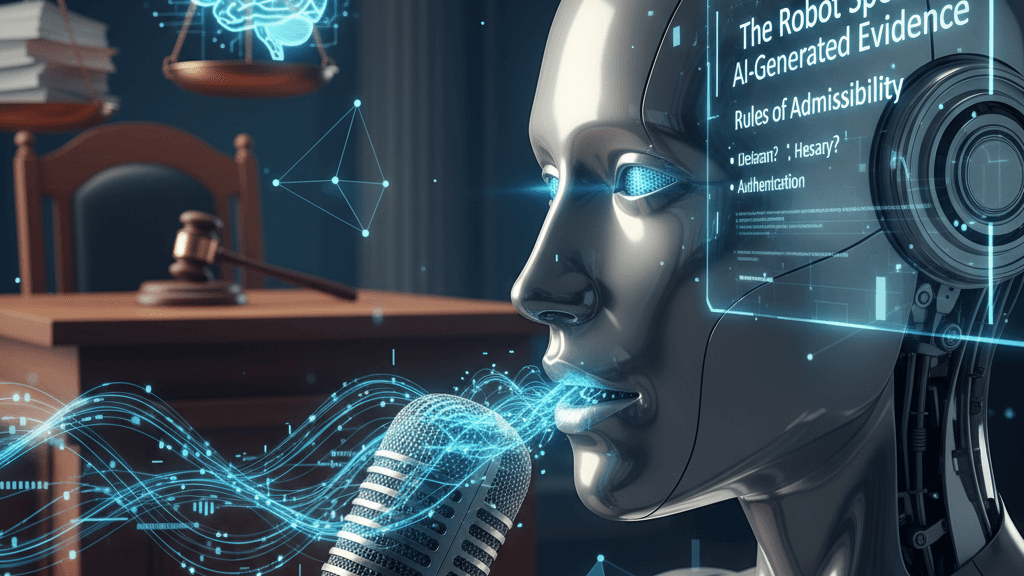
Artificial Intelligence (AI) is transforming industries worldwide, and the legal system in Nigeria is no exception. From facial recognition to predictive analytics, AI‑generated evidence is increasingly being presented in courtrooms. But the pressing question remains: can Nigerian courts admit such evidence, and under what conditions?
What Counts as AI‑Generated Evidence
- Facial recognition matches used in criminal investigations
- Voice‑print analyses for identity verification
- Deepfake videos and synthetic digital content
- Algorithmic risk assessments in criminal justice
- Predictive policing outputs
These forms of evidence are products of machine learning systems and fall under the umbrella of “computer‑generated evidence” recognized by Nigeria’s Evidence Act 2011 (Section 84) and updated in the Evidence Act Amendment 2023.
Nigerian Legal Framework
- Evidence Act 2011 (Section 84): Recognized electronic and computer‑generated evidence.
- Evidence Act Amendment 2023: Updated provisions but did not explicitly regulate AI outputs. Courts must still apply the general test of reliability and proper functioning of the system.
- Judicial literacy gap: Many judges lack technical knowledge of AI, complicating authentication and admissibility.
🔑 Admissibility Challenges
- Authentication: Courts require proof that evidence came from the claimed source and was not tampered with. AI outputs are often opaque (“black box”), complicating this.
- Bias and reliability: Algorithms may embed bias, raising fairness concerns.
- Confrontation rights: Section 36(6)(d) of the Nigerian Constitution guarantees the right to confront adverse evidence. With AI, defendants cannot cross‑examine a machine.
- Risk of manipulation: Deepfakes and edited digital content can easily be fabricated, undermining trust.
🌍 Comparative Lessons
- United States & UK: Courts demand disclosure of algorithmic methods and reliability testing.
- South Africa: A 2025 case highlighted dangers of lawyers submitting AI‑generated fictitious case law.
- European Union: Moving toward structured reliability standards for AI evidence.
Risks & Recommendations
- Risk: Admitting AI evidence without safeguards could erode fair‑hearing rights.
- Recommendation: Nigeria should adopt structured reliability standards, enforce disclosure obligations, and train judges in digital forensics.
- Best practice: Treat AI outputs as supporting evidence, not standalone proof, until stronger regulations exist.
Conclusion
AI‑generated evidence presents both opportunities and challenges for Nigerian law. While it can enhance efficiency and accuracy, its admissibility must be carefully regulated to protect fairness and justice. The future of Nigerian courts will depend on how quickly they adapt to the realities of digital evidence.